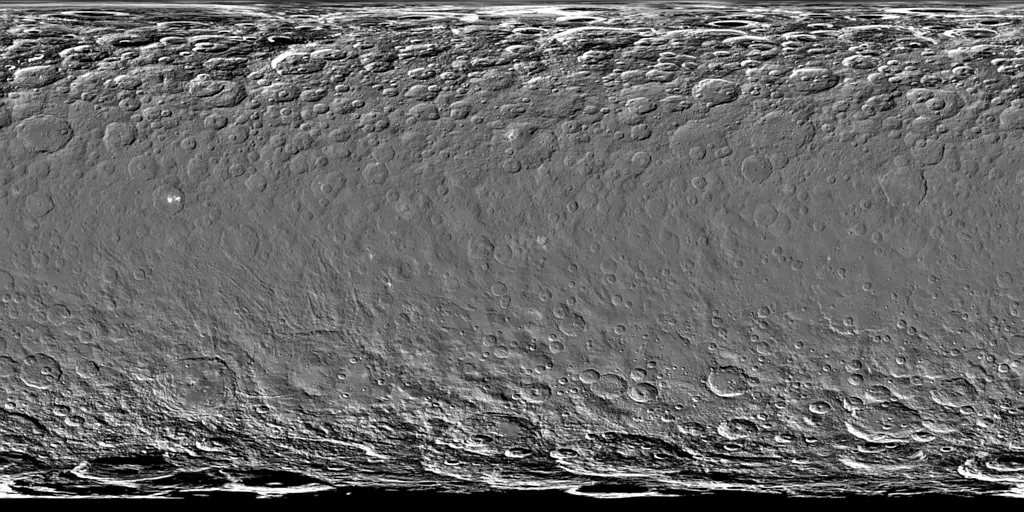
← World catalog DWARF PLANET / 08
Ceres
Asteroid belt
An ice-rich dwarf planet with brines, salts, organics, and evidence of geologically recent cryovolcanic activity.
BEvidence classStrong inference from multiple independent measurements
- Mean radius
- 469.7 km
- Surface gravity
- 0.27 m/s²
- Representative temperature
- about −105 °C mean surface
- Surface pressure
- Transient exosphere
Scientific assessment
Dawn observations indicate long-lived brine reservoirs and recent material transfer at Occator and other sites.
- Liquid-water evidence
- Brines and ice-rich crust; no confirmed global ocean
- Principal constraint
- Small energy budget and discontinuous liquid reservoirs
- Principal mission context
- NASA Dawn archive
Separated context matrix
Six editorial comparison inputs are shown separately. They are not combined into a probability of habitability or life. Conditional research priorities are calculated only in the scenario laboratory with visible assumptions, uncertainty and hard eligibility gates.
Ceres / System profile
Measured and inferred parameters are labeled by evidence class.
A
Directly observed or repeatedly measured
B
Strong inference from multiple independent measurements
C
Model-dependent or indirect interpretation
D
Unknown or not yet constrained
Interior architecture
A layered physical model from observable surface to uncertain deep interior.
01A
Dark regolith
Hydrated minerals, salts and carbon-bearing compounds are widespread.
02B
Ice-rich crust
Ground ice and mechanically mixed rock form the outer shell.
03B
Occator brine system
Bright sodium-carbonate deposits record geologically recent brine ascent.
04C
Partly differentiated interior
A global present ocean is not required by current data.
Matter and energy pathways
Processes that connect solvent, chemistry, energy and environmental persistence.
1
B Impact heat → brine mobilization
Occator’s impact system enabled ascent and deposition.
2
B Freezing brine → salt faculae
Evaporation and freezing concentrate sodium carbonates.
Evidence ledger
Claims remain separate from the observations or models that support them.
Water ice and hydrated minerals
BasisDawn spectroscopy, imaging and neutron measurements.
Recent brine activity
BasisOccator facula composition and crater chronology.
Global surviving ocean
BasisNot required; liquid may be regional and discontinuous.
Biology
BasisNo direct sample and limited ongoing energy.
Observation chronology
The measurements and missions that changed the scientific interpretation.
Dawn enters orbit and begins global mapping.
Dawn maps ice, organics, salts and gravity.
Occator studies strengthen the deep-brine interpretation.
Knowledge frontier
Unresolved questions and the observation needed to reduce uncertainty.
Q01C
Do brines persist today?
Resolution pathRepeat thermal mapping, radar and landed geochemistry.
Q02D
How are organics distributed at depth?
Resolution pathHigh-resolution spectroscopy and sampling.
Competing explanations
The evidence is read against alternatives. A habitable environment, a detectable signal and a biological explanation are separate claims.
Test this world in the scenario simulator →Scientific state vector
Uncertainty and decision laboratory
A reproducible Rust ensemble propagates uncertainty through the declared decision scenario. Results are conditional research priorities, never probabilities of life.
Ready to calculate
Local sensitivity
Knowledge gaps and mission design
The engine ranks uncertainty that can change a decision, then compares mission architectures under explicit resource constraints.
Priority knowledge gaps
Calculating…
Mission architecture sandbox
Calculating…
Comparative research model — not a flight design or cost estimate.