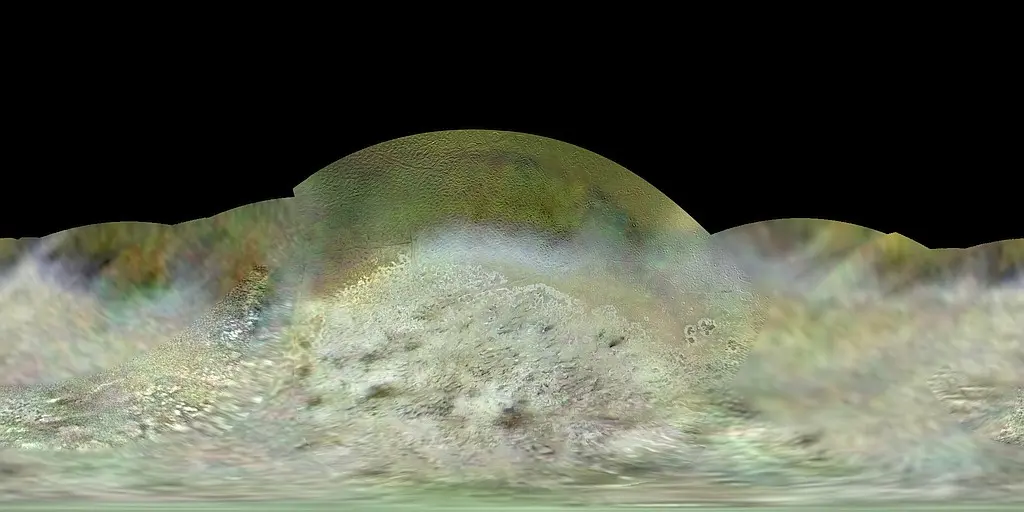
← World catalog MOON / 09
Triton
Neptune
A geologically active captured moon with nitrogen geysers and a possible deep ocean maintained by internal heat.
CEvidence classModel-dependent or indirect interpretation
- Mean radius
- 1,353.4 km
- Surface gravity
- 0.779 m/s²
- Representative temperature
- about −235 °C surface
- Surface pressure
- about 0.014 mbar
Scientific assessment
Voyager 2 established active surface processes, while the interior ocean remains a model-dependent hypothesis awaiting new measurements.
- Liquid-water evidence
- Possible internal ocean, model-dependent
- Principal constraint
- Sparse coverage and no dedicated orbiter
- Principal mission context
- Voyager 2 archive; future mission concepts
Separated context matrix
Six editorial comparison inputs are shown separately. They are not combined into a probability of habitability or life. Conditional research priorities are calculated only in the scenario laboratory with visible assumptions, uncertainty and hard eligibility gates.
Triton / System profile
Measured and inferred parameters are labeled by evidence class.
A
Directly observed or repeatedly measured
B
Strong inference from multiple independent measurements
C
Model-dependent or indirect interpretation
D
Unknown or not yet constrained
Interior architecture
A layered physical model from observable surface to uncertain deep interior.
01A
Nitrogen frost cap
Seasonal volatile transport controls albedo and pressure.
02A
Young cantaloupe terrain
Sparse craters and unusual tectonics imply resurfacing.
03C
Ice-rock mantle
Radiogenic and tidal history may retain internal heat.
04C
Possible ocean
A liquid layer is physically plausible but not detected geophysically.
Matter and energy pathways
Processes that connect solvent, chemistry, energy and environmental persistence.
1
A Sunlight → nitrogen sublimation
Seasonal heating drives atmosphere and frost migration.
2
B Solar heating → geyser plumes
Voyager observed dark active plumes likely driven through translucent ice.
Evidence ledger
Claims remain separate from the observations or models that support them.
Active nitrogen plumes
BasisVoyager 2 imaging in 1989.
Young resurfaced terrains
BasisGeomorphology and low crater density.
Internal ocean
BasisThermal evolution models only.
Biology
BasisNo measurements of liquid material or interior chemistry.
Observation chronology
The measurements and missions that changed the scientific interpretation.
Triton discovered shortly after Neptune.
Voyager 2 conducts the only close reconnaissance.
Atmosphere monitored remotely; no return mission approved.
Knowledge frontier
Unresolved questions and the observation needed to reduce uncertainty.
Q01D
Is there a present internal ocean?
Resolution pathOrbiter gravity, induction, radar and heat-flow measurements.
Q02C
What drives recent resurfacing?
Resolution pathGlobal high-resolution imaging and geologic chronology.
Competing explanations
The evidence is read against alternatives. A habitable environment, a detectable signal and a biological explanation are separate claims.
Test this world in the scenario simulator →Scientific state vector
Uncertainty and decision laboratory
A reproducible Rust ensemble propagates uncertainty through the declared decision scenario. Results are conditional research priorities, never probabilities of life.
Ready to calculate
Local sensitivity
Knowledge gaps and mission design
The engine ranks uncertainty that can change a decision, then compares mission architectures under explicit resource constraints.
Priority knowledge gaps
Calculating…
Mission architecture sandbox
Calculating…
Comparative research model — not a flight design or cost estimate.