← World catalog PLANET / 01
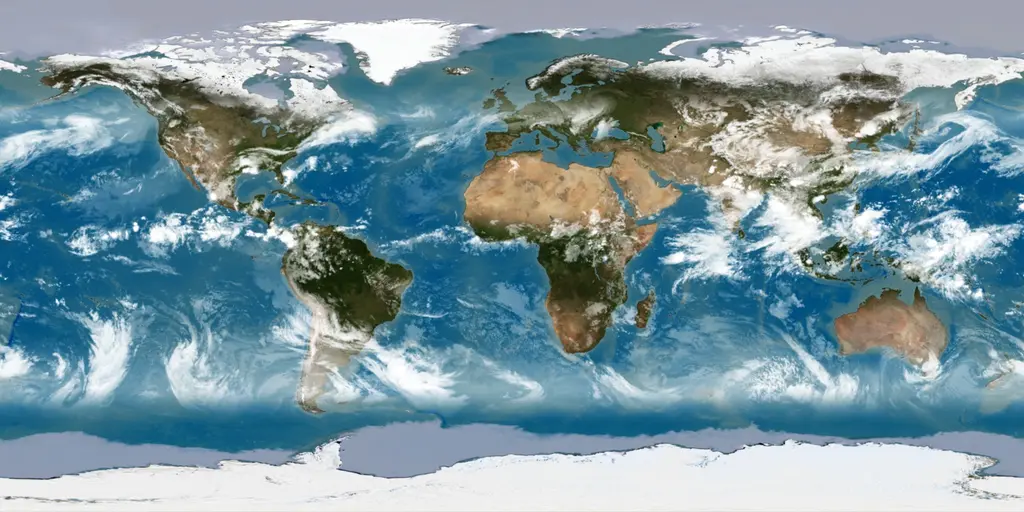
Earth
Solar System
The only known inhabited world and the empirical benchmark for every habitability comparison.
AEvidence classDirectly observed or repeatedly measured
- Mean radius
- 6,371 km
- Surface gravity
- 9.807 m/s²
- Representative temperature
- +15 °C mean surface
- Surface pressure
- 1,013 mbar mean sea level
Scientific assessment
Persistent surface oceans, active geochemistry, atmospheric regulation, and a long-lived biosphere define the benchmark case.
- Liquid-water evidence
- Global surface ocean, directly observed
- Principal constraint
- Benchmark, not a target
- Principal mission context
- Earth-observing satellite constellations
Separated context matrix
Six editorial comparison inputs are shown separately. They are not combined into a probability of habitability or life. Conditional research priorities are calculated only in the scenario laboratory with visible assumptions, uncertainty and hard eligibility gates.
Earth / System profile
Measured and inferred parameters are labeled by evidence class.
A
Directly observed or repeatedly measured
B
Strong inference from multiple independent measurements
C
Model-dependent or indirect interpretation
D
Unknown or not yet constrained
Interior architecture
A layered physical model from observable surface to uncertain deep interior.
01A
Atmosphere
Weather, climate regulation and radiative balance.
02A
Ocean and biosphere
A global solvent network coupled to living carbon, nitrogen and sulfur cycles.
03A
Mobile lithosphere
Plate tectonics renews crust and mediates long-term carbon exchange.
04A
Mantle and core
Convection drives volcanism; the liquid outer core sustains the dynamo.
Matter and energy pathways
Processes that connect solvent, chemistry, energy and environmental persistence.
1
A Solar energy → climate
Atmosphere and ocean redistribute incoming radiation.
2
A Rock → ocean nutrients
Weathering and hydrothermal systems supply bioessential elements.
3
A Biosphere ↔ atmosphere
Life strongly modifies atmospheric chemistry and surface redox state.
Evidence ledger
Claims remain separate from the observations or models that support them.
Life and liquid surface water
BasisDirect observation and sampling.
Long-term climate feedbacks
BasisInstrumental records, paleoclimate archives and physical models.
Frequency of Earth-like outcomes
BasisOne inhabited reference world cannot constrain occurrence rates.
Observation chronology
The measurements and missions that changed the scientific interpretation.
Planet formed.
Abundant evidence of early life.
Continuous era of orbital observation begins.
Only confirmed inhabited comparison standard.
Knowledge frontier
Unresolved questions and the observation needed to reduce uncertainty.
Q01D
How did life originate?
Resolution pathPrebiotic chemistry, geology and laboratory reconstruction.
Q02C
How resilient is planetary habitability?
Resolution pathCoupled climate–biosphere observation across timescales.
Competing explanations
The evidence is read against alternatives. A habitable environment, a detectable signal and a biological explanation are separate claims.
Test this world in the scenario simulator →Scientific state vector
Uncertainty and decision laboratory
A reproducible Rust ensemble propagates uncertainty through the declared decision scenario. Results are conditional research priorities, never probabilities of life.
Ready to calculate
Local sensitivity
Knowledge gaps and mission design
The engine ranks uncertainty that can change a decision, then compares mission architectures under explicit resource constraints.
Priority knowledge gaps
Calculating…
Mission architecture sandbox
Calculating…
Comparative research model — not a flight design or cost estimate.