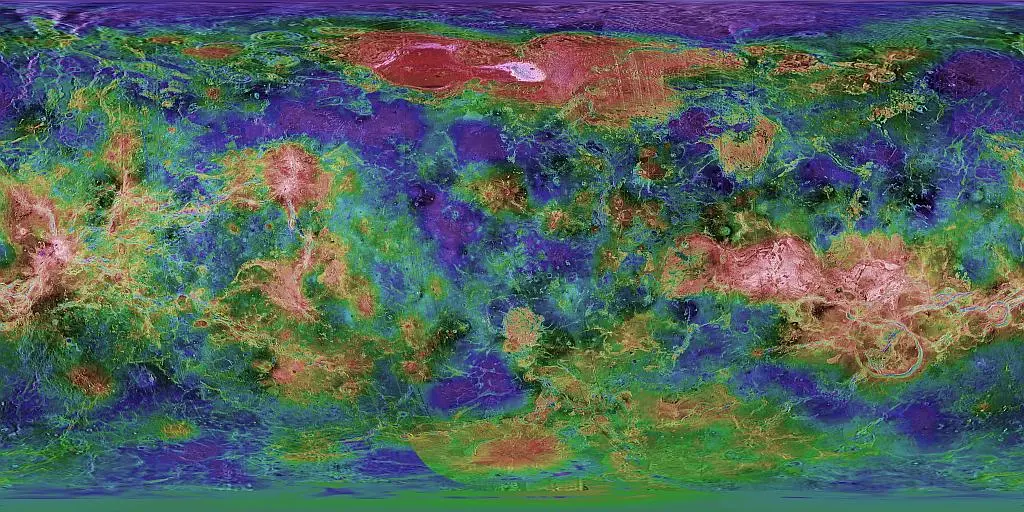
← World catalog PLANET / 10
Venus
Solar System
A terrestrial boundary case whose runaway greenhouse climate defines a critical limit on planetary habitability.
AEvidence classDirectly observed or repeatedly measured
- Mean radius
- 6,051.8 km
- Surface gravity
- 8.87 m/s²
- Representative temperature
- about +464 °C surface
- Surface pressure
- about 92,000 mbar
Scientific assessment
The surface is sterile by known standards; the cloud-layer habitability hypothesis remains unconfirmed and requires direct chemical measurements.
- Liquid-water evidence
- No stable surface water; ancient water history unresolved
- Principal constraint
- Extreme heat, pressure, and corrosive atmosphere
- Principal mission context
- Magellan archive; DAVINCI, VERITAS, EnVision
Separated context matrix
Six editorial comparison inputs are shown separately. They are not combined into a probability of habitability or life. Conditional research priorities are calculated only in the scenario laboratory with visible assumptions, uncertainty and hard eligibility gates.
Venus / System profile
Measured and inferred parameters are labeled by evidence class.
A
Directly observed or repeatedly measured
B
Strong inference from multiple independent measurements
C
Model-dependent or indirect interpretation
D
Unknown or not yet constrained
Interior architecture
A layered physical model from observable surface to uncertain deep interior.
01A
Sulfuric-acid clouds
Global cloud decks reflect sunlight and host complex photochemistry.
02A
Super-rotating atmosphere
Winds circle the planet far faster than the solid body rotates.
03A
Hot basaltic surface
Radar reveals volcanic plains, tesserae and deformed highlands.
04C
Mantle and core
Present tectonic and volcanic state remains incompletely known.
Matter and energy pathways
Processes that connect solvent, chemistry, energy and environmental persistence.
1
A CO₂ greenhouse → extreme heat
Dense atmosphere traps outgoing infrared radiation.
2
B UV + H₂O → hydrogen escape
Isotopic enrichment records extensive past water loss.
3
C Volcanism → atmospheric renewal
Possible present activity could couple interior and atmosphere.
Evidence ledger
Claims remain separate from the observations or models that support them.
Runaway-greenhouse surface
BasisDirect lander measurements and atmospheric physics.
Major ancient water loss
BasisElevated atmospheric deuterium-to-hydrogen ratio.
Long-lived early ocean
BasisClimate outcomes depend strongly on initial conditions and clouds.
Cloud-layer biology
BasisNo confirmed biosignature; severe acidity and low water activity.
Observation chronology
The measurements and missions that changed the scientific interpretation.
Venera probes directly measure atmosphere and surface.
Magellan radar maps most of the surface.
Venus Express studies atmospheric escape and dynamics.
DAVINCI, VERITAS and EnVision target atmosphere, geology and evolution.
Knowledge frontier
Unresolved questions and the observation needed to reduce uncertainty.
Q01C
Did Venus ever sustain an ocean?
Resolution pathNoble gases, D/H, tessera geology and coupled climate models.
Q02C
Is volcanism active today?
Resolution pathRepeat radar, emissivity and atmospheric trace-gas measurements.
Competing explanations
The evidence is read against alternatives. A habitable environment, a detectable signal and a biological explanation are separate claims.
Test this world in the scenario simulator →Scientific state vector
Uncertainty and decision laboratory
A reproducible Rust ensemble propagates uncertainty through the declared decision scenario. Results are conditional research priorities, never probabilities of life.
Ready to calculate
Local sensitivity
Knowledge gaps and mission design
The engine ranks uncertainty that can change a decision, then compares mission architectures under explicit resource constraints.
Priority knowledge gaps
Calculating…
Mission architecture sandbox
Calculating…
Comparative research model — not a flight design or cost estimate.