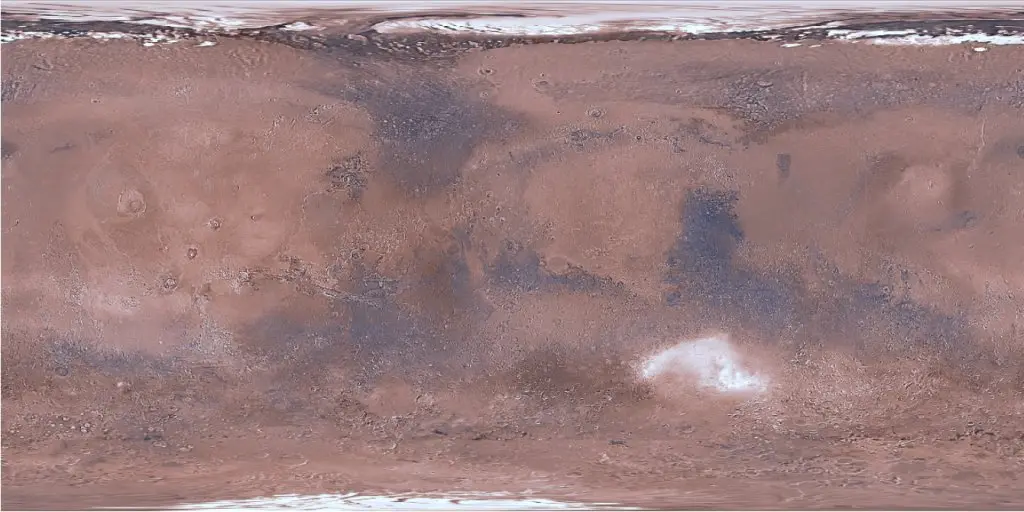
← World catalog PLANET / 05
Mars
Solar System
A once-water-rich planet with ancient rivers and lakes, persistent ground ice, and the most accessible extraterrestrial rock record.
AEvidence classDirectly observed or repeatedly measured
- Mean radius
- 3,389.5 km
- Surface gravity
- 3.721 m/s²
- Representative temperature
- about −63 °C global mean
- Surface pressure
- about 6.1 mbar mean
Scientific assessment
Present surface conditions are hostile, but ancient habitable environments are well documented and can be sampled directly by landed missions.
- Liquid-water evidence
- Ancient rivers and lakes; present ice and transient brines debated
- Principal constraint
- Radiation, aridity, and low pressure
- Principal mission context
- Mars orbital and landed mission fleet
Separated context matrix
Six editorial comparison inputs are shown separately. They are not combined into a probability of habitability or life. Conditional research priorities are calculated only in the scenario laboratory with visible assumptions, uncertainty and hard eligibility gates.
Mars / System profile
Measured and inferred parameters are labeled by evidence class.
A
Directly observed or repeatedly measured
B
Strong inference from multiple independent measurements
C
Model-dependent or indirect interpretation
D
Unknown or not yet constrained
Interior architecture
A layered physical model from observable surface to uncertain deep interior.
01A
Oxidizing surface
UV radiation, perchlorates, dust and extreme dryness challenge preservation.
02A
Sedimentary archive
Deltas, lake beds and hydrated minerals record ancient water.
03A
Cryosphere
Water ice persists at poles and beneath much of the surface.
04C
Deep subsurface
Potential protected habitats and liquid reservoirs remain poorly constrained.
Matter and energy pathways
Processes that connect solvent, chemistry, energy and environmental persistence.
1
B Ancient atmosphere → rivers and lakes
A thicker early atmosphere supported episodic or sustained surface water.
2
B Atmospheric loss → cold desert
Solar-wind escape and climate evolution removed surface stability.
3
A Rock record → returned sample
Cached samples preserve context for laboratory-scale tests.
Evidence ledger
Claims remain separate from the observations or models that support them.
Ancient habitable lakes
BasisSedimentology, mineralogy and rover chemistry.
Indigenous organic molecules
BasisOrganics measured in ancient sedimentary rocks; origin unresolved.
Present subsurface habitability
BasisIce is confirmed, but liquid stability and chemistry are model-dependent.
Past or present life
BasisNo confirmed biosignature.
Observation chronology
The measurements and missions that changed the scientific interpretation.
Viking performs the first dedicated life-detection experiments.
Orbiters and rovers establish the planet’s aqueous history.
Curiosity characterizes an ancient habitable lake environment.
Perseverance explores Jezero delta and caches samples.
Knowledge frontier
Unresolved questions and the observation needed to reduce uncertainty.
Q01D
Did life ever arise on Mars?
Resolution pathReturned samples, contamination-controlled organics and microscopy.
Q02C
Where is accessible subsurface water?
Resolution pathRadar, neutron mapping, drilling and seismic surveys.
Competing explanations
The evidence is read against alternatives. A habitable environment, a detectable signal and a biological explanation are separate claims.
Test this world in the scenario simulator →Scientific state vector
Uncertainty and decision laboratory
A reproducible Rust ensemble propagates uncertainty through the declared decision scenario. Results are conditional research priorities, never probabilities of life.
Ready to calculate
Local sensitivity
Knowledge gaps and mission design
The engine ranks uncertainty that can change a decision, then compares mission architectures under explicit resource constraints.
Priority knowledge gaps
Calculating…
Mission architecture sandbox
Calculating…
Comparative research model — not a flight design or cost estimate.