← World catalog MOON / 04
Titan
Saturn
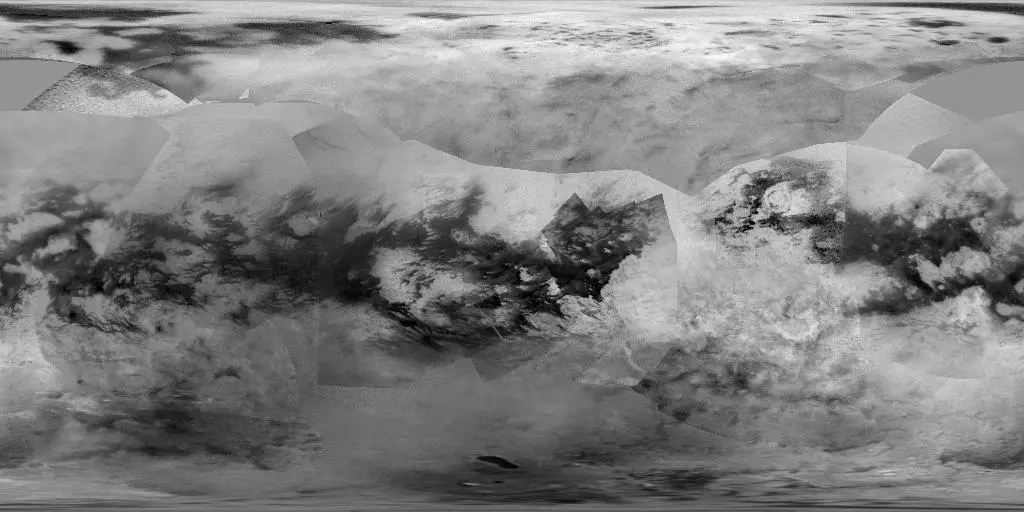
A chemically rich world with a dense nitrogen atmosphere, methane weather, surface lakes, and a probable interior water ocean.
BEvidence classStrong inference from multiple independent measurements
- Mean radius
- 2,574.7 km
- Surface gravity
- 1.352 m/s²
- Representative temperature
- about −179 °C surface
- Surface pressure
- about 1,467 mbar
Scientific assessment
Titan offers two distinct solvent regimes: hydrocarbons at the surface and a water-rich reservoir inferred at depth.
- Liquid-water evidence
- Surface methane–ethane lakes; probable subsurface water ocean
- Principal constraint
- Extreme cold and uncertain exchange with the interior
- Principal mission context
- Cassini–Huygens archive; NASA Dragonfly
Separated context matrix
Six editorial comparison inputs are shown separately. They are not combined into a probability of habitability or life. Conditional research priorities are calculated only in the scenario laboratory with visible assumptions, uncertainty and hard eligibility gates.
Titan / System profile
Measured and inferred parameters are labeled by evidence class.
A
Directly observed or repeatedly measured
B
Strong inference from multiple independent measurements
C
Model-dependent or indirect interpretation
D
Unknown or not yet constrained
Interior architecture
A layered physical model from observable surface to uncertain deep interior.
01A
Organic haze
Photochemistry builds aerosols and complex carbon compounds.
02A
Methane landscape
Clouds, rain, channels, dunes, lakes and seas form an active surface cycle.
03B
Ice crust and high-pressure layers
The water-rich shell likely separates surface organics from the deep interior.
04B
Subsurface ocean
Gravity, rotation and deformation support a salty liquid reservoir.
Matter and energy pathways
Processes that connect solvent, chemistry, energy and environmental persistence.
1
A Sunlight → atmospheric organics
Methane and nitrogen photochemistry produces complex material.
2
A Methane evaporation ↔ rainfall
A hydrological analogue reshapes the surface.
3
D Surface ↔ ocean exchange
The efficiency and timescale of exchange remain unknown.
Evidence ledger
Claims remain separate from the observations or models that support them.
Surface hydrocarbon seas
BasisCassini radar and near-infrared mapping.
Complex atmospheric chemistry
BasisCassini–Huygens in situ and remote measurements.
Deep water ocean
BasisTidal deformation and interior models.
Life in methane or water
BasisNo diagnostic sample or biosignature.
Observation chronology
The measurements and missions that changed the scientific interpretation.
Cassini maps atmosphere, surface and gravity.
Huygens lands and images a rounded-ice landscape.
NASA selects Dragonfly.
Dragonfly planned to investigate habitability chemistry on the surface.
Knowledge frontier
Unresolved questions and the observation needed to reduce uncertainty.
Q01C
Can surface organics reach liquid water?
Resolution pathGeophysics, impact-melt studies and Dragonfly chemistry.
Q02C
How stable is the methane climate?
Resolution pathLong-baseline atmospheric and lake monitoring.
Competing explanations
The evidence is read against alternatives. A habitable environment, a detectable signal and a biological explanation are separate claims.
Test this world in the scenario simulator →Scientific state vector
Uncertainty and decision laboratory
A reproducible Rust ensemble propagates uncertainty through the declared decision scenario. Results are conditional research priorities, never probabilities of life.
Ready to calculate
Local sensitivity
Knowledge gaps and mission design
The engine ranks uncertainty that can change a decision, then compares mission architectures under explicit resource constraints.
Priority knowledge gaps
Calculating…
Mission architecture sandbox
Calculating…
Comparative research model — not a flight design or cost estimate.